Telescopic Boom Lift Rental in the UAE: How to Read Height and Outreach Before You Hire
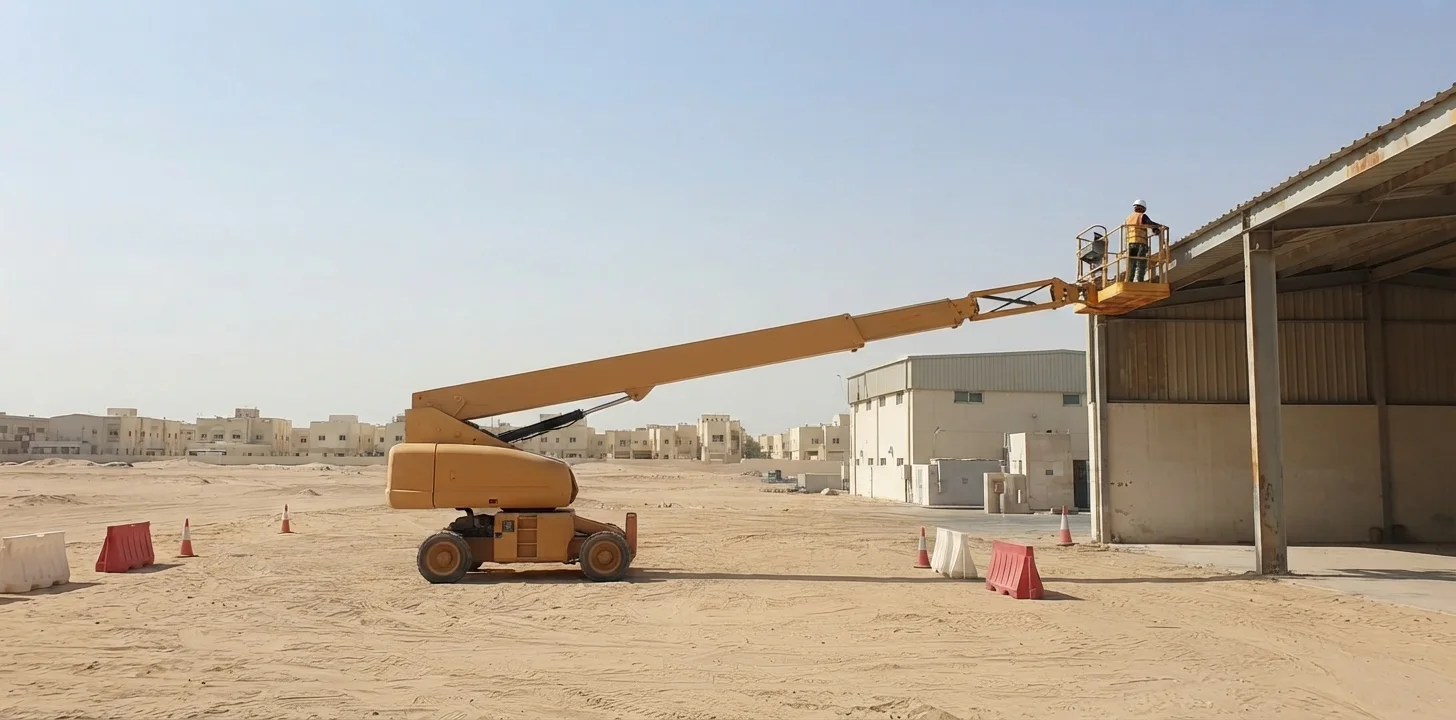
A brochure promises a 30 m telescopic boom. The crew drives it onto a slab, extends it, and still cannot reach a work point only 15 m away horizontally because the machine is sitting too far back and the working envelope does not allow full height and full outreach at the same time. Telescopic boom lift rental fails most often when the headline number is treated as the usable figure.
Six Lines on the Spec Sheet That Matter
|
Spec line |
What it really means |
The trap |
|
Platform height |
Height of the platform floor above ground |
Not the same as working height |
|
Working height |
Platform height plus about 2 m for a person reaching |
Easy to confuse with platform height |
|
Horizontal outreach |
How far the platform can reach out from the centre |
Maximum height and maximum outreach are rarely available together |
|
Capacity |
Maximum load in the platform (people + tools + materials) |
Restricted capacity often applies at longer reach |
|
Weight and footprint |
Machine mass and stowed or working dimensions |
Ground bearing, ramps and slabs may not take it |
|
Travel and gradeability |
How it drives and climbs on site |
Rough ground and soft fill can stop it |
Read these six lines before the big number on the front of the brochure.
Reading One Spec Sheet: An Illustrative Example
Illustrative model only (not an Aman machine): mid-size rough-terrain telescopic boom. Platform height 22 m, working height about 24 m, horizontal outreach 16 m at a lower boom angle, unrestricted capacity 230 kg, restricted capacity 450 kg in a shorter envelope, machine weight 12 t, 4x4 drive, foam-filled tyres.
Apply it to a job: steel connection work on a warehouse frame. The standing position is 12 m from the column line and the work face is 18 m above ground. The working-envelope chart shows that at 12 m outreach the platform can still reach the required height while carrying two people and tools within the unrestricted rating. The 12 t weight is acceptable on the compacted yard, but the same machine would need ground protection or a different standing position on a suspended slab. The headline “24 m” alone would not have told you any of this.
Which Size Band Fits the Job?
These are general bands; models vary.
About 15–20 m platform height
Typical for lower warehouse steel, tank maintenance at moderate height, and
many industrial inspection jobs. Watch-out: outreach is shorter, so the machine
must stand closer to the work.
About 20–30 m platform height
Common for larger steel structures, plant pipe racks, and mid-height façade or
signage work. Watch-out: weight and transport size increase quickly; check
offloading space and ground bearing.
30 m and above
Used for high industrial structures, large hangars, stadiums and tall
inspection work. Watch-out: wind effect is greater at height and the working
envelope becomes more restricted at full extension.
Ask us for the telescopic models currently available once you know the required height and outreach.
Ground, Slopes and Getting Around Site
Most telescopic boom lifts are self-propelled on large rubber tyres with 4x4 drive and are built for rough outdoor ground. They still need firm, level support when the boom is elevated. Soft sand, uncompacted fill, steep slopes and weak covers over services or basements are common failure points. Gradeability figures on the spec sheet assume firm ground; real site conditions are often less forgiving. Ground protection mats are frequently required on finished slabs or soft areas.
Wind, Heat and Dust at Height
Outdoor machines are commonly limited to around 12.5 m/s (about 45 km/h) wind speed; the manufacturer’s chart and the machine data plate govern. Readings at platform height matter more than ground-level readings. UAE shamal winds and summer temperatures above 45 °C affect both the machine’s cooling and the operator’s ability to work safely. Dusty sites increase filter and cooling demands.
Getting It to Site
Large telescopic booms normally travel on a trailer or lowbed trailer. Confirm gate widths, overhead clearances, turning circles and hard-standing for the transporter and for offloading. Overhead power lines must be identified and clearance maintained. Site access that looks adequate for a smaller machine can stop a large boom before it ever reaches the work area.
What to Send Us for a Quote
- Required platform or working height
- Horizontal distance from the only possible standing position to the work face
- Any obstacles in the path
- Ground type, slope and any known weak spots
- Indoor or outdoor
- Number of people plus tools and materials
- Duration
- Power preference
- Emirate and precise location
- Site access details (gates, height limits, offloading space)
Clear information lets us match the right unit without repeated clarification.
When a Telescopic Boom Is the Wrong Choice
When the work sits up and over an obstacle rather than in a clear line of sight, an articulated boom lift is usually the better tool. Multiple stops along public roads favour a truck-mounted manlift. Tight indoor spaces or narrow access often suit a spider lift. For a broader overview of boom types see /blog/boom-lift-rental-uae. When a straight boom with long outreach is the right answer, start with the range of telescopic boom lifts.
Across the Seven Emirates
Ports and industrial yards in Dubai and Sharjah generate steady demand for mid-to-large telescopic machines on firm open ground. Steel buildings and process plants in Abu Dhabi and Ajman need the combination of height and outreach that only a straight boom provides. Factories in Ras Al Khaimah and Umm Al Quwain often work within tighter yards where standing position and weight become critical. Port and tank-farm areas in Fujairah add the extra constraints of soft ground and wind exposure. The same six-line reading of the spec sheet works in every emirate.
FAQ
What should I check first for telescopic boom lift rental
UAE?
The horizontal distance from the standing position to the work face, and
whether the working envelope allows the required height at that outreach.
How far can a telescopic boom reach sideways?
Horizontal outreach commonly ranges from about 10 m to 25 m depending on the
model. Maximum height and maximum outreach are not available at the same time;
the envelope chart shows the actual combination.
Can a telescopic boom work on sand or uneven ground?
Rough-terrain models with 4x4 drive handle compacted and moderately uneven
ground. Soft sand, steep slopes and weak fill still require careful
positioning, ground protection and, in many cases, a different machine or
standing point.
Does the platform capacity stay the same at full reach?
No. Many models list an unrestricted capacity (commonly around 227–300 kg) and
a higher restricted capacity that applies only in a reduced part of the
envelope. Always check the load chart for the actual boom position.
Measure the outreach you actually need, then call +971 56 700 9776 or email info@amanrental.com and we will match the right telescopic boom lift for your UAE site.