
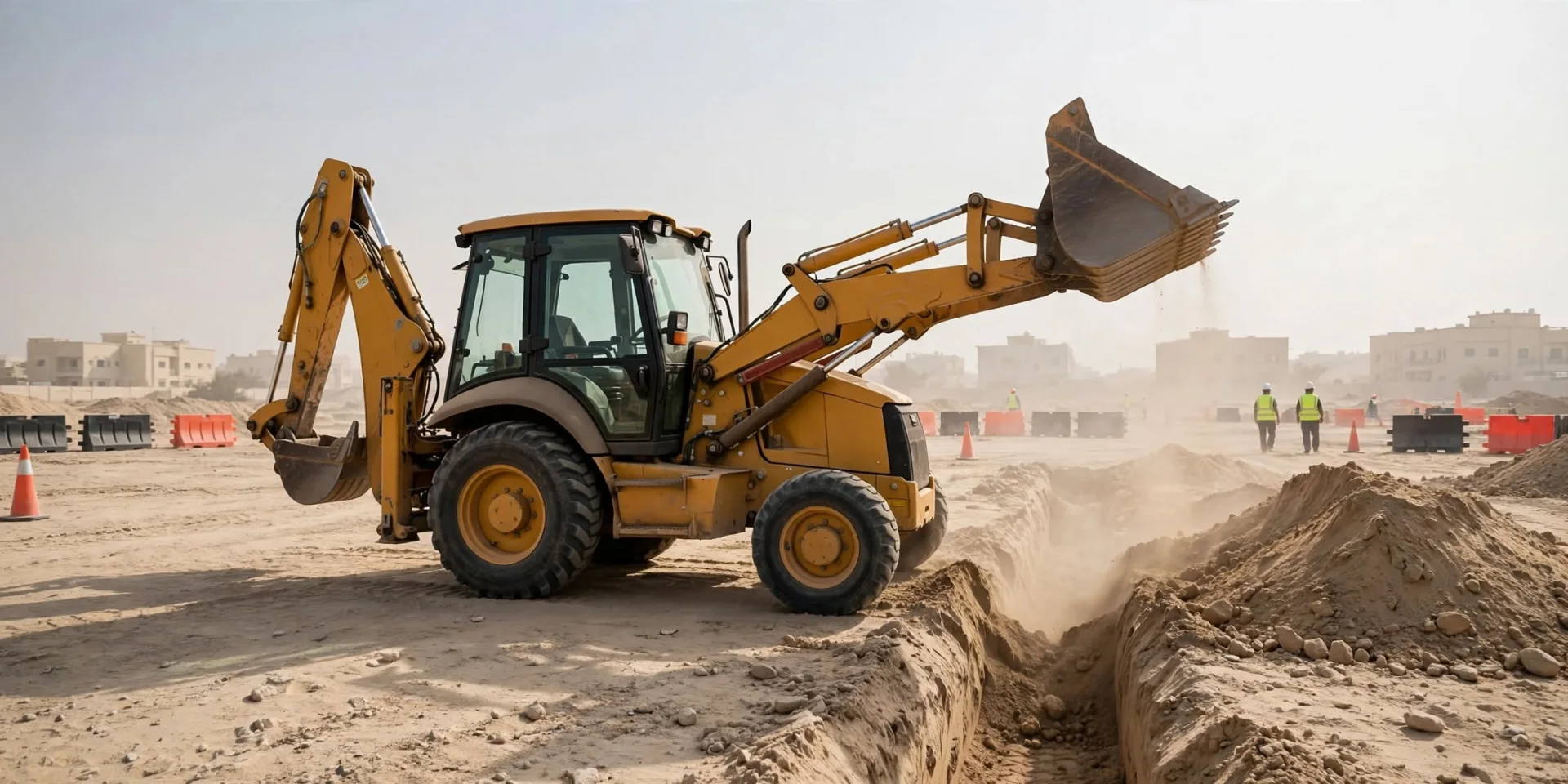
JCB Backhoe Loader Rental in the UAE: What the Digging End and the Loading End Each Do
A contractor hired a small excavator for the trenches and a separate loader for the spoil. By midday both machines had spent more time waiting than working. One JCB backhoe loader would have covered the whole job. That is the point of the machine: two ends, one operator, one hire.
One Machine, Two Ends
A backhoe loader is a tractor-style machine with a front loader bucket and a rear digging arm. The operator turns the seat to switch between them. The front end loads, carries, levels and backfills. The rear end digs trenches, footings and pits.
In the UAE many people simply say “JCB” when they mean any backhoe loader. “3CX” is one specific JCB model name. When you ask for JCB backhoe loader rental you are usually describing the class of machine, not a single brand or model. Ask us for the backhoe loaders currently available and we will match the specification to the work.
Split Your Job by Hours
Before you book, split the day into the hours that need the digging end and the hours that need the loading end.
Illustrative worked example (not a real Aman job)
A small villa plot needs a drainage line: 80 m of trench, 1.2 m deep, spoil
stacked then backfilled, and the surface graded. Rough split:
- Digging and trimming the trench – about 60 % of the hours
- Loading spoil into a tipper and backfilling – about 30 %
- Final levelling and clean-up – about 10 %
One backhoe loader can handle all three stages without a second machine standing idle. Rule of thumb: if either end of the machine is needed for less than about 10–15 % of the total hours, a dedicated excavator or a dedicated loader may be a cleaner fit.
What Each End and Attachment Does
|
Part or attachment |
Best for |
Watch-out |
|
Front loader bucket |
Loading trucks, moving spoil, levelling |
Not for deep digging |
|
Backhoe bucket |
General trenching and footings |
Width must match the trench |
|
Trench bucket |
Narrow trenches for pipes and cables |
Lower capacity than a general bucket |
|
Hydraulic breaker |
Breaking small slabs and rock |
Noise, dust and vibration limits |
|
Auger |
Post holes and light foundations |
Ground conditions affect torque |
|
Forks |
Handling palletised materials |
Rated capacity is lower than digging |
|
Sideshift & extendable dipper |
Digging close to walls and kerbs, extra depth |
Confirm they are fitted on the unit |
Dig Depth, Reach and Stabilisers
Dig depth is the vertical distance the bucket can reach below ground level with the stabilisers down. Common figures for this class sit between about 4 m and 6 m depending on model and whether an extendable dipper is fitted. Stabilisers (outriggers) must be lowered onto firm ground before any digging begins; the machine is not designed to dig on its tyres alone. A sideshift backhoe lets the digging arm slide sideways so you can work close to walls, fences and kerbs without constantly repositioning the whole machine.
Before the Bucket Goes In: Services and Ground
Locate and mark every underground service—power, water, telecom, gas and drainage—through the relevant authority or the site’s permit process. Never assume the ground is clear. In sand and loose fill, trench walls can collapse quickly; shoring or battering may be required. Spoil needs somewhere to go; a tipper truck is often the practical partner for removing material from the site. Barriers and exclusion zones keep people and vehicles clear of the working area. Summer heat above 45 °C and dry sand both affect trench stability and tyre wear.
What to Send Us for a Quote
- Type of work (trenching, footings, loading, breaking, etc.)
- Trench or hole depth and width
- Approximate quantity of material to move
- Attachments needed (breaker, trench bucket, auger, forks)
- Ground type (sand, fill, rock, mixed)
- Access width and any height limits
- Duration
- Emirate and precise location
- Whether an operator is required
Clear answers let us match the right unit without repeated site visits.
When a Backhoe Loader Is the Wrong Machine
Large bulk excavation or deep digging is usually faster with a crawler excavator. Very tight or indoor access often suits a mini excavator. Flat clearing, grading or loading in confined spaces can be better handled by a skid-steer loader. High-volume loading all day is the job of a wheel loader. When the work genuinely needs both a digging end and a loading end on the same site, the backhoe loader (JCB) is the practical single-machine answer.
Across the Seven Emirates
Villa plots and utility connections in Sharjah and Ajman keep backhoe loaders busy on short trenches and backfill. Infrastructure and roadworks in Dubai and Abu Dhabi use them for drainage, ducting and kerb-line work. Farms and landscaping jobs in Ras Al Khaimah and Umm Al Quwain favour the ability to dig, move and level without changing machines. Mountain and wadi-edge sites in Fujairah add the need for machines that can travel short distances on their own wheels between closely spaced tasks. The same hours-split logic applies in every emirate.
FAQ
What is jcb backhoe loader rental typically used for?
Trenching for pipes and cables, foundation digs, backfilling, loading spoil,
levelling and light breaking work on small-to-medium sites.
What is a JCB 3CX?
The 3CX is one model name in the JCB backhoe-loader range. In everyday UAE
speech “JCB” often means any machine of this type. Confirm the actual
specification when you enquire.
How deep can a backhoe loader dig?
Typical dig depths for this class sit between about 4 m and 6 m depending on
the model and whether an extendable dipper is fitted. Always check the
machine’s data plate and the ground conditions.
Can it break concrete?
With a hydraulic breaker fitted, yes, for small slabs and light rock. Noise,
dust and vibration limits on the site still apply.
Tell us how the hours split between digging and loading, then call +971 56 700 9776 or email info@amanrental.com and we will match the right backhoe loader for your UAE job.